Foundational Thinking is not just a philosophy. It is a mental model, a repeatable thought process designed to help you move from confusion to clarity, and from clarity to intentional action. Whether applied to personal growth, leadership decisions, or business strategy, the process remains the same: understand what’s foundational, identify what drives outcomes, and iterate deliberately.
Quick Start: Run the Process in 20 Minutes
If you want to apply Foundational Thinking immediately, start here.
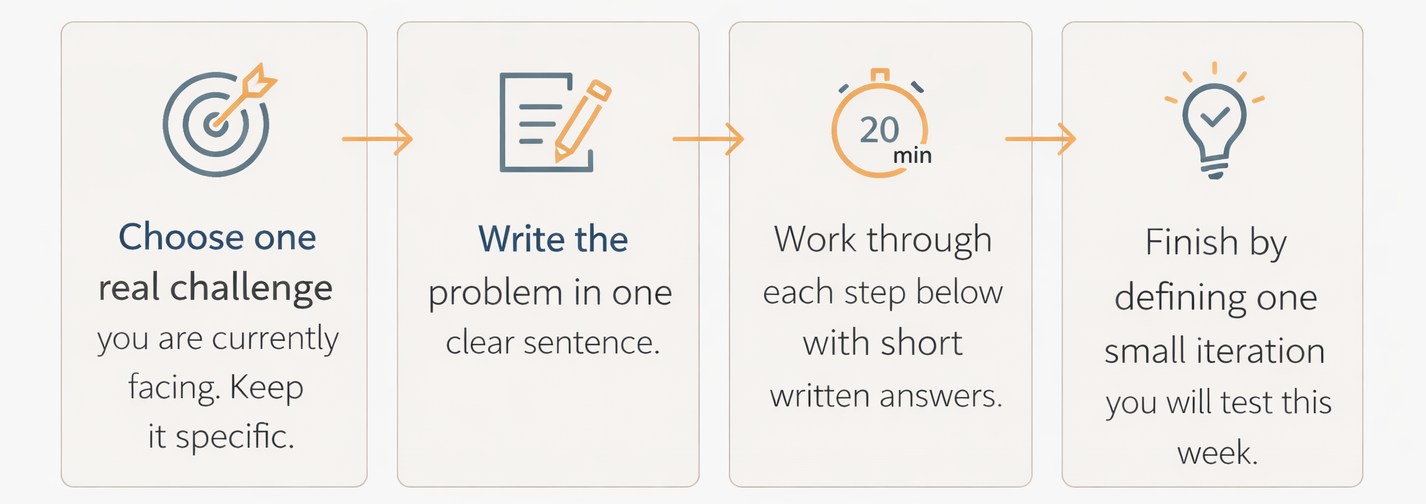
- Choose one real challenge you are currently facing. Keep it specific.
- Write the problem in one clear sentence.
- Work through each step below with short written answers.
- Finish by defining one small iteration you will test this week.
This process is designed to be best used under real conditions, not studied in isolation.
How the Process Works
The Foundational Thinking Process expands the core model — Understand, Identify, Iterate — into five practical steps. Each step builds on the previous one, ensuring that action is grounded in clarity rather than assumption.
Step 1: Understand: Uncovering the Foundation
Every outcome is shaped by underlying beliefs, assumptions, associated thoughts, and feelings. The first step is to understand them.
Potential questions/prompts:
- What assumptions am I making about this situation?
- What do I believe must be true for this problem to exist?
- Which beliefs feel inherited, unexamined, or outdated?
Derived output:
You should leave this step with a clearer view of the assumptions and ideas that are shaping your thinking.
Step 2: Identify the Key Drivers
Not all factors matter equally. This step is about distinguishing what truly will influence outcomes from what merely creates noise.
Potential questions/prompts:
- What variables most strongly affect this situation?
- Which constraints limit progress right now?
- Where does leverage actually exist?
Derived output:
You should be able to articulate the few drivers that truly matter.
Step 3: Develop a First Principles Perspective
Instead of copying solutions or refining existing approaches, return to fundamentals. Utilize the principle of Unlearning.
Potential Questions\Prompts:
- If I ignored existing solutions, how would I approach this from scratch?
- What must be true for a solution to work long-term?
- What is essential versus convenient?
Output line:
You should have a solution concept rooted in fundamental truths, not habit or convention.
Step 4: Iterate Through Action
Progress does not require certainty. It requires movement informed by feedback.
Potential questions/prompts:
- What is the smallest meaningful action I can take?
- How will I know if it’s working?
- What am I willing to adjust if results differ from expectations?
Derived output:
You should define a single, testable action to take with the plan to iterate towards improvement/completion in the real world.
Step 5: Embed the Process
Foundational Thinking is most powerful when it becomes a habit, not an event.
Potentials questions/prompts:
- What did I learn from this process?
- What assumptions changed as a result?
- How will I apply this process again?
Derived output:
You should leave with refined understanding, direct action taken, and a repeatable way of thinking towards achieving sustainable growth.
Apply the Process to a Current Challenge
The Foundational Thinking Process is designed to be used across contexts, personal growth, leadership, business strategy, and innovation. The structure stays the same; the application adapts to your reality.
If you want to work through the process with guidance, or apply it inside your organization, we can do that together.

